
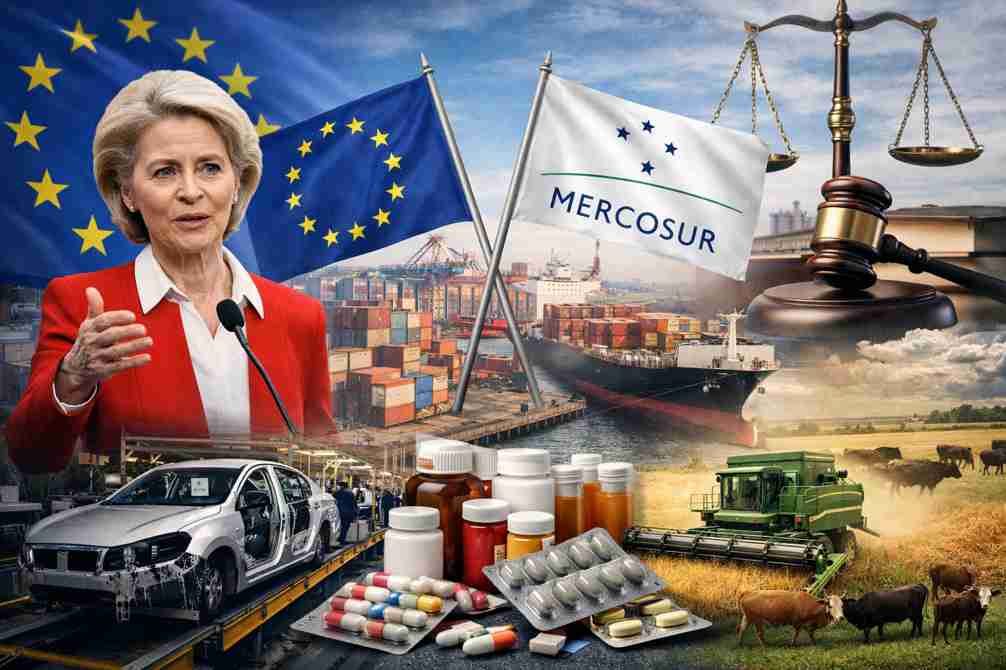
The European Union is pushing ahead with one of the largest free trade projects in its history. Despite ongoing legal review by the European Court of Justice, the trade agreement with the South American Mercosur countries is to be partially implemented ahead of schedule. This could open up new market opportunities for export-oriented countries like Austria, while concerns remain in the agricultural sector.
Provisional application prior to final ratification
EU Commission President Ursula von der Leyen announced in Brussels that parts of the agreement with Brazil, Argentina, Uruguay, and Paraguay will soon be provisionally applied. Uruguay and Argentina had previously ratified the treaty, thus fulfilling a key prerequisite.
Provisional application means that companies can benefit from lower tariffs and simplified trading conditions even before the treaty formally enters into force. However, final approval at the EU level could be delayed for a long time. In January, the European Parliament decided to have the treaty reviewed by the European Court of Justice before the final vote.
Uncertain timetable for legal review
It is currently unclear how long the legal assessment will take. Experience from comparable cases shows that expert opinions can take between 16 and 26 months. There is no fixed deadline for a decision.
Critics are particularly critical of the decision-making process itself. They object to the fact that such a comprehensive trade agreement did not necessarily require unanimous approval from all member states. Furthermore, there are concerns that European standards for environmental, consumer, and animal protection could come under pressure. The European Commission, however, rejects these accusations.
Great economic opportunities for European industry
Advantages for the automotive, mechanical engineering and pharmaceutical industries
The agreement was signed in Paraguay at the beginning of the year after more than 25 years of negotiations – despite resistance from individual EU states such as France and Poland. The aim is to create a free trade area with approximately 720 million inhabitants.
European industry, in particular, could benefit. Currently, import duties on cars in Mercosur countries can reach up to 35 percent. Eliminating such duties would make vehicles from Europe significantly more competitive.
The mechanical engineering and pharmaceutical industries also see great potential. For Austria, whose economy is heavily dependent on the export of high-quality industrial goods, this could open up additional sales markets, particularly in Brazil, the region’s largest market.
Brazil and Paraguay are also expected to benefit from the new regulations once they have completed their national ratification procedures.
Political signal for open world trade
The EU also sees the agreement as a geopolitical signal. In light of increasing trade conflicts and protectionist measures, particularly from the US, Europe wants to strengthen its international partnerships.
Von der Leyen described the agreement as a platform for closer political and economic cooperation with partners who are committed to open and rules-based trade. This would allow Europe to strengthen its economic independence.
Resistance from the agricultural sector remains strong.
Concern about cheap imports from South America
The agreement is viewed particularly critically by European farmers‘ associations. They fear increased competition from cheaply produced agricultural products from South America, such as beef or poultry.
In Austria, agricultural representatives also regularly express concerns, as domestic farms often have higher production costs compared to international prices. This particularly affects smaller, family-run farms, which are typical of the Austrian agricultural structure.
Protective mechanisms are intended to prevent price pressure.
To secure approval in Europe, additional safeguard clauses were agreed upon. These stipulate that the EU can intervene quickly if import volumes increase sharply or prices for European producers fall significantly.
In such cases, tariff concessions could be temporarily suspended to stabilize the domestic market.
The agreement remains economically significant and politically controversial.
The planned free trade zone between the EU and the Mercosur countries is one of the largest trade projects worldwide. While export-oriented industries anticipate new opportunities, resistance persists from parts of the agricultural sector and the political sphere.
The provisional application could already show concrete economic effects in the coming months. However, the ultimate future of the agreement depends significantly on the decision of the European Court of Justice and further political approval within the EU.

Wilbert Stumpf schreibt für Presseraum.at über Politik, Wirtschaft, Technologie, Sport, Unterhaltung und Lifestyle. Er legt Wert auf klare Berichterstattung, aktuelle Entwicklungen und relevante Geschichten, die Leserinnen und Leser verständlich und zuverlässig informieren.
You may also like
-
Arbeitsmarkt in Deutschland stabilisiert sich – echte Erholung lässt weiter auf sich warten
-
Graz in Österreich testet intelligente Verkehrssensoren von LMT / Artikel
-
Bosnien sucht österreichische Unterstützung für Frontex-Statusabkommen – EURACTIV.com
-
Die österreichische Zentralbank senkt die BIP-Wachstumsprognose für 2016 und 2017
-
Österreich verabschiedet Resolution, die Holodomor in der Ukraine als „entsetzliches Verbrechen“ bezeichnet; Russland reagiert