
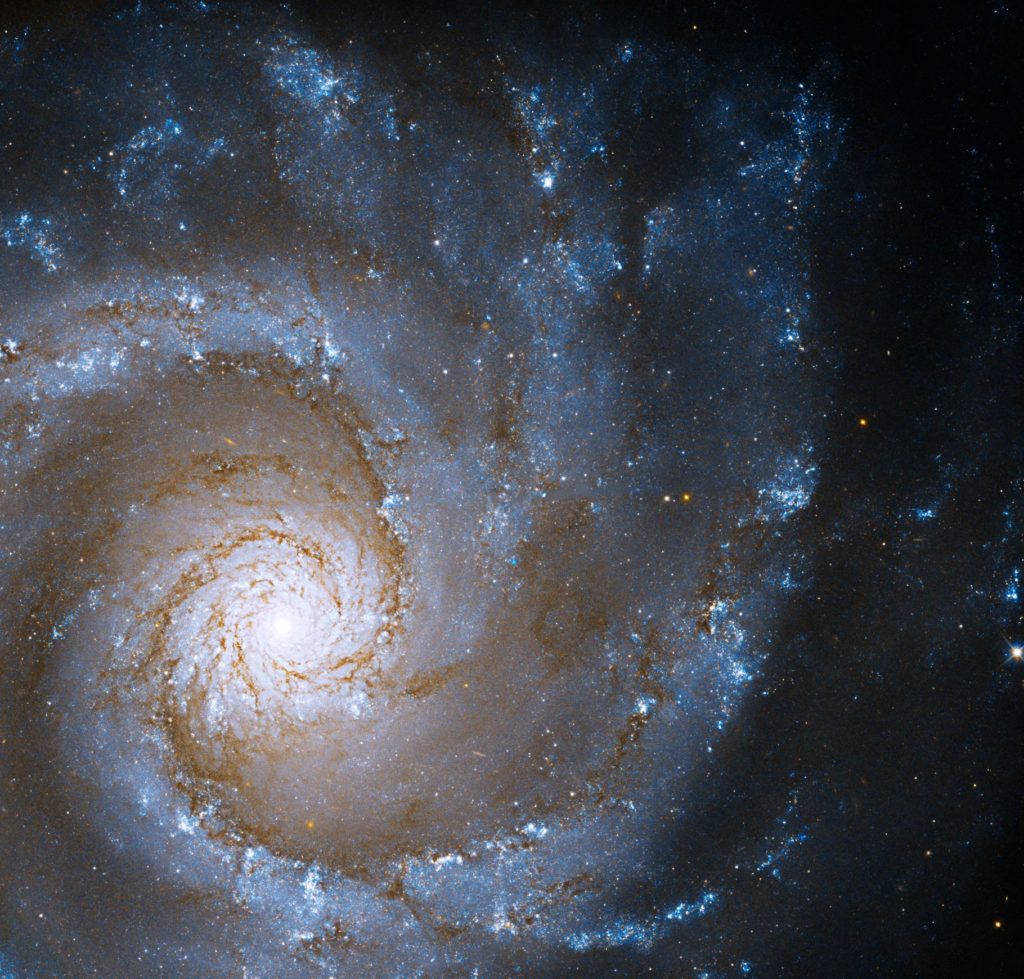
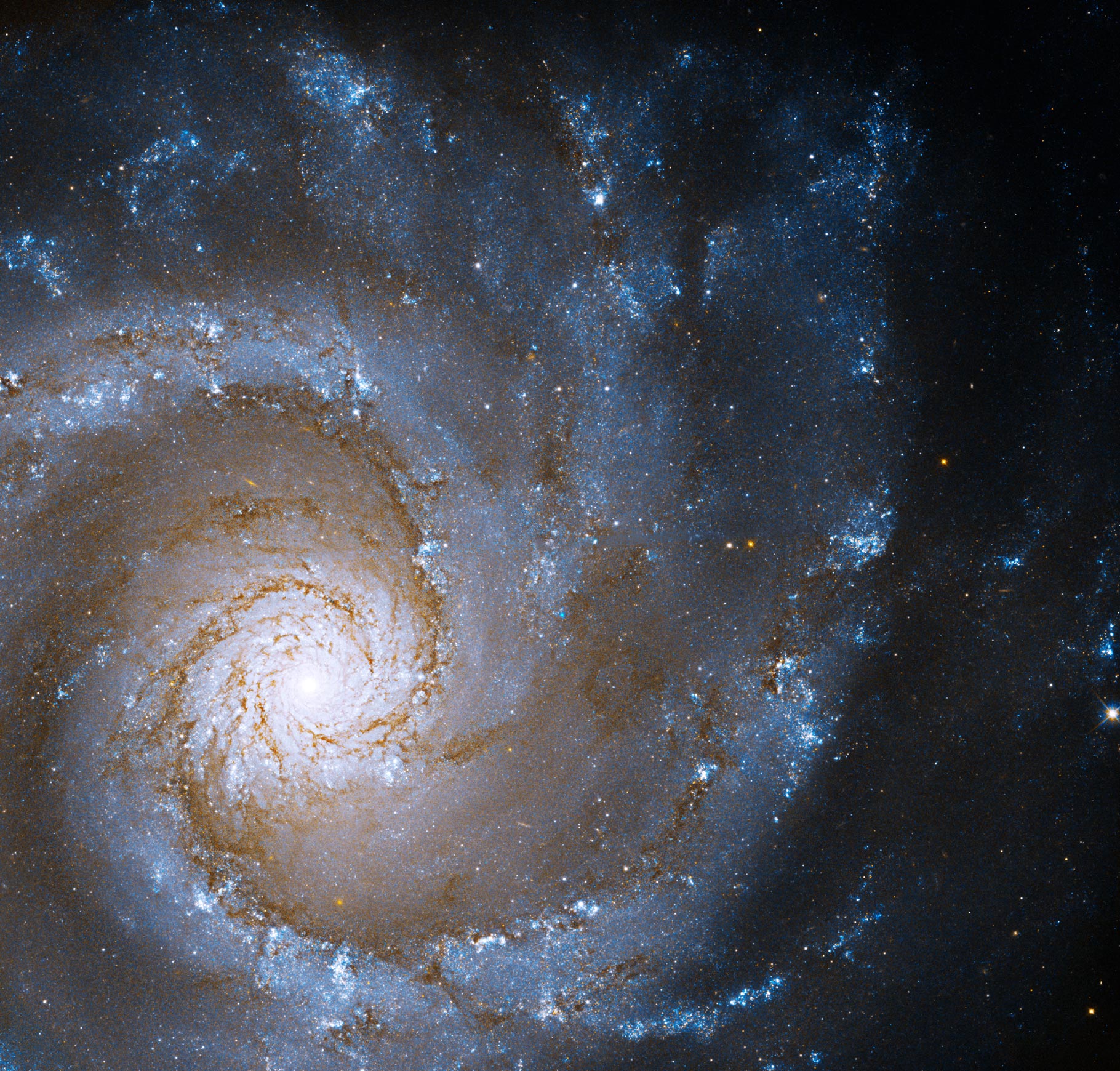
Bild des Hubble-Weltraumteleskops von NGC 3631, der Grand Design Spiral, die sich etwa 53 Millionen Lichtjahre entfernt im Sternbild Großer Bär befindet. Bildnachweis: NASA, ESA, A. Filippenko (University of California – Berkeley) und D. Sand (University of Arizona); Bildbearbeitung: G. Kober (NASA Goddard/Catholic University of America)
Dieses Bild von[{“ attribute=““>NASA’s Hubble Space Telescope features the Grand Design Spiral, NGC 3631, located approximately 53 million light-years away in the direction of the constellation Ursa Major. The “arms” of grand design spirals appear to wind around and into the galaxy’s nucleus.
In contrast to multi-arm and flocculent spirals, which have softer structural elements, a grand design spiral galaxy has obvious and well-defined spiral arms. A grand design galaxy’s spiral arms stretch clearly across the galaxy through many radians and may be seen over a considerable proportion of the galaxy’s radius.
Close inspection of NGC 3631’s grand spiral arms reveals dark dust lanes and bright star-forming regions along the inner part of the spiral arms. Star formation in spirals is similar to a traffic jam on the interstate. Like cars on the highway, slower-moving matter in the spiral’s disk creates a bottleneck, concentrating star-forming gas and dust along the inner part of their spiral arms. This traffic jam of matter can get so dense that it gravitationally collapses, creating new stars (seen here seen in bright blue-white).
The image uses data collected from Hubble’s Wide Field Camera 3 and Advanced Camera for Surveys. The color blue represents visible wavelengths of blue light, and the color orange represents infrared light.

August Baumann schreibt für Presseraum.at über Politik, Wirtschaft, Technologie, Sport, Unterhaltung und Lifestyle. Er legt Wert auf klare Berichterstattung, aktuelle Entwicklungen und relevante Geschichten, die Leserinnen und Leser verständlich und zuverlässig informieren.
You may also like
-
Rätselhaftes Objekt aus dem frühen Universum
-
Größte Karte des Universums umfasst mehr als fünf Billionen Pixel
-
Drei massereiche schwarze Löcher in einer jungen Galaxie entdeckt
-
Großer Asteroid passiert die Erde in sicherer Entfernung – Beobachtung mit Teleskopen möglich
-
Österreichische Gletscher ziehen sich „mehr denn je“ zurück: Messung